The Prince and the Plunder

A book on how Britain took one boy and piles of treasures from Ethiopia

Author: Andrew Heavens

A silver and silver gilt gauntlet

Published / by Andrew Heavens / Leave a Comment

What: A silver and gilded silver gauntlet, said to have belonged to Emperor Tewodros

Where: The Victoria & Albert Museum, Cromwell Rd, Knightsbridge, London SW7 2RL

The catalogue entry has three images and reads: “This arm defence was looted a British colonel after British troops stormed the Fortress of Magdala (Maqdala), Ethiopia, on 13 April 1868 to rescue foreign hostages held by the Emperor Tewodros. A note in the Museum register records that the object was ‘stated by the vendor to have been taken at the siege of Magdala, 1868, by Col. Macnaghten, Bombay Cavalry and to have been the property of King Theodore’. The V&A bought the armlet in 1922, for £12, from Mrs Louisa Macnaghten.”

Museum number:
M.140-1922

Silver gilt cup engraved ‘King of Kings, Theodore’

Published / by Andrew Heavens / Leave a Comment

What: A silver gilt cup engraved “King of Kings, Theodore”

Where: The Victoria & Albert Museum, Cromwell Rd, Knightsbridge, London SW7 2RL

The catalog entry describes: “Silver gilt cup with a beaded and fluted foot with filigree ornament, with a knop and similar ornament around the bowl, Abyssinia … Engraved “King of Kings, Theodore”

Museum number:
63-1870

Borrett’s ring

Published / by Andrew Heavens / Leave a Comment

What: A ring taken off a dead Ethiopian soldier’s finger after the Battle of Aroge, April 10 1868

Where: King’s Own Royal Regiment Museum, Market Square, Lancaster, LA1 1HT

The museum entry reads: Ring taken from a dead Abyssinian soldier by Lieutenant Borrett.

Accession Number: KO0467/04

Theodore’s cup

Published / by Andrew Heavens / Leave a Comment

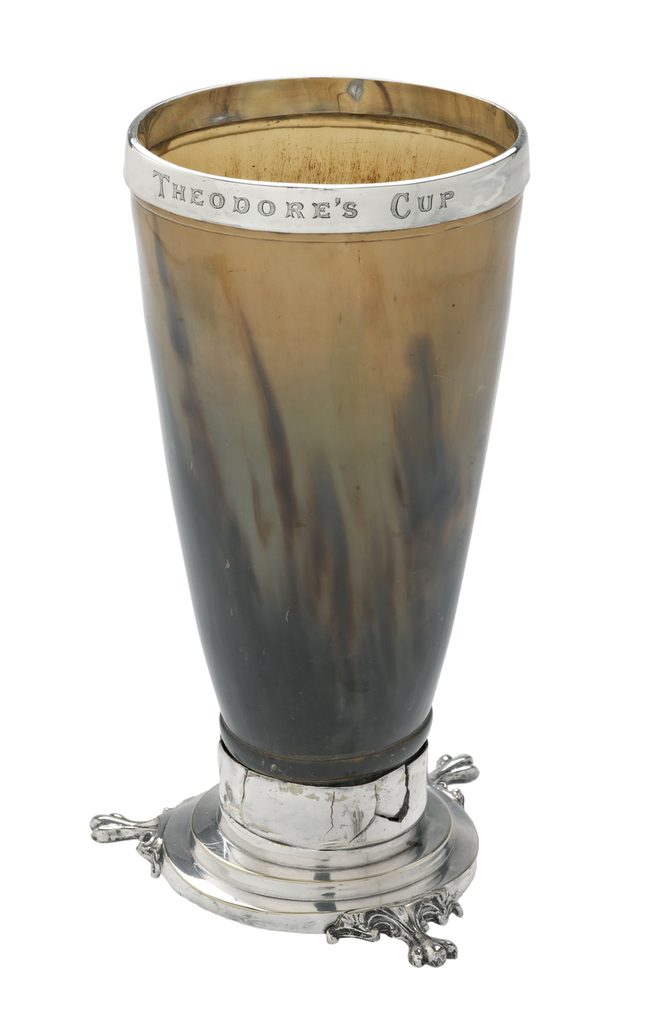
What: A horn cup, mounted in silver engraved “Theodore’s Cup”

Where: National War Museum, Edinburgh Castle, Edinburgh, EH1 2NG

The museum’s catalogue entry has one image

National Museums of Scotland spreadsheet
Accession number: M.1949.215
Description: Theodore cup of horn with silver mounts, taken by Paymaster Major Thomson after the Storming of Magdala, Abyssinia, 1868
Acquisition source: Miss C.E. McLeod, Overseas Club [Inverness]

Silver gilt paten inscribed with the emperor’s name

Published / by Andrew Heavens / Leave a Comment

What: A silver gilt paten, inscribed with the emperor’s name, taken by the British Museum’s expert on the expedition, Richard Rivington Holmes

Where: The British Museum, Great Russell St, Bloomsbury, London WC1B 3DG

Provenance: Maqdala mentioned at length in acquisition notes. Paten marked with Tewodros’s name.

The catalogue entry reads:

“Paten made of silver gilt engraved with holy images on uppermost surface and Ge’ez inscriptions around the rim. In the centre of the paten is the representation of Christ as the sacrificial lamb, to the left is the Virgin Mary with a cross on her mantle and an elaborate halo. She kneels before the lamb; tears are shown on her face and her hands are raised in grief. To the right are two identical bearded men in tears, with hands raised in grief. Below the lamb is a semi prostrate figure of a man in priest’s robes. Around the edge of the paten are eleven figures which represent Christ’s followers, all bearded and wearing hooded priests’ robes. Around the internal surface of the raised rim are seven angels.”

Inscription Translation: “This paten […] (for the) house of Mary was given by Emperor Tewodros for the deliverance of his body and soul.”

Detail
Museum number: Af1868,1001.11
Field Collection by: Sir Richard Rivington Holmes
Acquisition date: 1868

The emperor’s throne cloth

Published / by Andrew Heavens / Leave a Comment

What: Throne cloth made of gold thread and velvet

Where: The Duke of Wellington’s Regimental Museum, Bankfield Museum, Boothtown Road, Halifax, West Yorkshire, HX3 6HG

“Mr Rigby Wason has most kindly and generously presented to the Regiment the throne-cloth of King Theodore of Abyssinia, which formed part of the loot obtained by his cousin, Capt. Sandys Wason, of the 33rd Regiment, in the Abyssinian War. The throne-cloth is a really magnificent piece of work, containing more gold thread than velvet, and is approximately 12ft. by 8ft. in dimension.”
Article in the regimental magazine The Iron Duke, 1949

The cloth can be seen draped over the back of the display dedicated to the Abyssinian Campaign at the Halifax museum.