One of four processional crosses taken from Magdala by The King’s Own Royal Regiment. They were put on display in The King’s Own Regimental Memorial Chapel in Lancaster Priory.
“In Abyssinia [now Ethiopia] in 1868 the Regiment recovered four Coptic Crosses from a heap of scrap brass awaiting recycling into guns at an arsenal at Magdala. The crosses probably date from the 4th or 5th century.
“The largest of these is used as a processional cross. The only [known] other one used for this purpose is in Westminster Abbey. Two smaller crosses are on display in this Chapel.
“Illustrations on the crosses are simple engravings of Gospel stories, including the Nativity, Crucifixion, the Deposition and Resurrection.”
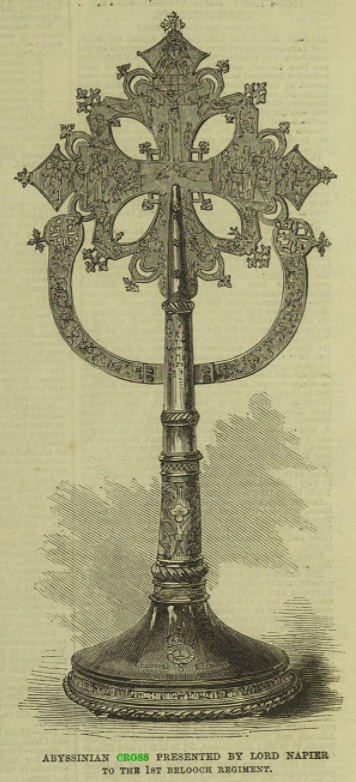
What: A silver processional cross presented by Napier to the 1st Belooch Regiment. It was placed on a silver stand made in Birmingham and was meant to be an ornament for the regiment’s Mess.
Where: Exact location unknown. The 1st Belooch Regiment is one of the precursors of Pakistan’s modern-day Baloch Regiment which is based in Abbottabad.
Illustrated London News engraving
The Illustrated London News ran an article on the cross in its Aug. 28, 1869 issue:
ABYSSINIAN CROSS PRESENTED BY LORD NAPIER TO THE 1ST BELOOCH REGIMENT “Our readers will certainly recollect that, among the multitude of Illustrations we gave last year of the strange incidents of the British expedition to Abyssinia, were several crosses, and other church utensils or ornaments, either sent to this country as trophies, or seen and delineated by our Special Artist. The cross shown in an Engraving this week is part of the spoils of Magdala. This curious piece of work is about 150 years old. The head of the cross is formed of pure silver, very soft and ductile. It is decorated with engraved groups and figures chiefly illustrative of the history of Christ, according to the ideas of the Greek Church. On the obverse is represented, at its apex, Christ, crowned with thorns, undergoing his crucifixion with the two thieves. At the base of the cross are introduced the Blessed Virgin and St. John, with two cherubim. The betrayal of Our Lord, the flight of the soldiers, the scene of his being dragged between the houses of Herod and Pilate, St. Peter cutting off the servant’s ear, and the insulting act coupled with the question “Prophesy who struck Thee,” are represented on the transverse arms of the cross. On the reverse, at its apex, is shown God the Father as an aged man, placed above a space in which are introduced the Madonna and Child, and the background of which is formed by a curtain held up by two cherubim. St. George of Cappadocia is shown on horseback in the act of slaying the dragon. St. Michael is also represented in a characteristic attitude. The extreme points of the transverse arms on this side bear representations of the miracles of casting out a devil and curing the blind. The member of the cross which forms the blade of the shaft bears representations on both sides of the Fathers of the Desert. The interstices not occupied by figure-subjects are decorated with ornaments of a peculiar character, very curiously interlaced. This is well displayed in the flat circular band which springs from the shaft of the cross on each side, and supports the transverse arms. The shaft of the cross has engraved upon it an inscription in native characters, the translation of which is as follows :- “Presented by Colonel Welda Hunna to the Church of St. Raphael at Gondar.”
“This cross has been presented by Lord Napier to the 1st Belooch Regiment, who have had it fitted up in a silver vase by Messrs. Hardman and Co., of Birmingham, with the intention of using it as an ornament on their mess-table, to commemorate the part taken by it in the capture of Magdala. The shaft of the stand, which is also of silver, is decorated with engraving en suite, and bears the following inscription round the base:-” Presented to the 1st Beloochees by his Excellency Lord Napier, G.C.B., G.C.S.I., Commander-in-Chief of the Abyssinian Expedition, in commemoration of the Fall of Magdala, 1868;” and on the regimental badge, engraved on the base, is inscribed :-” 1st Belooch Regiment-Delhi-Abyssinia.”
What: An 18th century manuscript including the Didascalia Apostolorum; the Mashafa Megbarat Sanayet or ‘the Book of Good Works,’ on the Services of the Church and the Duties of the Priest; the Faus Manfasawi, or Epitome of Canon Law; and the Fetha Nagast. The flyleaves and margins are covered with deeds (originals and copies) in Ge’ez and Amharic, including a deed of gift by Bakafa to the priests of the church of Raphael.
Where: The British Library, 96 Euston Rd, London NW1 2DB
What: An 18th century copy of the Fetha Nagast, or Justice of Kings. “Part second is slightly imperfect at the beginning, owing to a defect in the manuscript from which this copy was taken.”
Where: The British Library, 96 Euston Rd, London NW1 2DB